






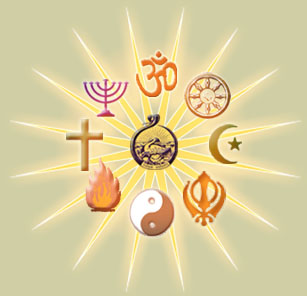
Vedanta developed within Hinduism specifically with the aim of bringing together the diverse sects of Hinduism, while recognizing that there is not only one religion, but that instead each of us can find or develop the religion that elevates his being.
The land and history of India have been propitious for religious encounters: Buddhism, Christianity and Islam have, since their origin, taken root in India, where the Sikh religion, Jainism, the Parsi religion, and others also exist. The Vedanta’s perspective on the various sects of Hinduism applies of course to all the other religions: each one is a path of truth, but none alone can fully account for the manifestations of the Infinite.
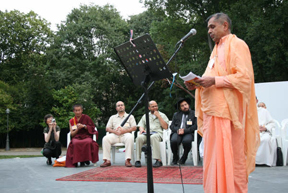
The Ramakrishna Mission has, among others, tasked itself with encouraging and participating in inter-religious dialogue. This has been so since its origin—indeed, one of the first public actions of Swami Vivekananda was to participate in the first World Parliament of Religions in Chicago in 1893.
The Centre Védantique Ramakrishna is a French “association” governed by a specific legal framework (Law 1901) and was registered at the Prefecture of Seine-et-Marne in 1953. Participation in the Centre’s activities does not require membership.
The aims of the association are the teaching of the Vedanta. For this purpose, and thanks to the generosity of many donors, the association acquired a property in 1948 located at 64 Boulevard Victor Hugo in Gretz-Armainvilliers in Seine-et-Marne, which is both its headquarters and site of activities.
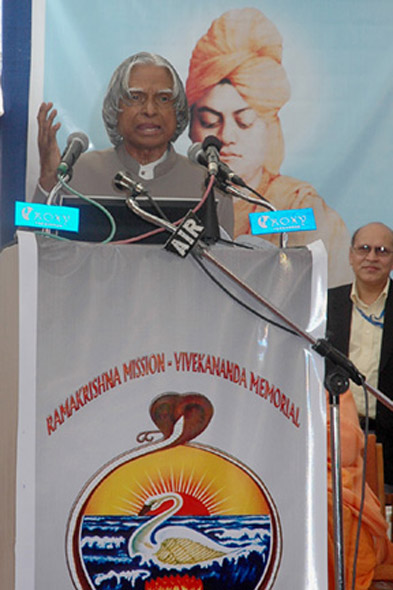
Thanks to his own influence, as well as that of Swami Vivekananda, Ramakrishna is known beyond India. Indeed, the Nobel laureate Romain Rolland published a biography of Ramakrishna in 1929, while in 1932 the philosopher Henri Bergson referred to Ramakrishna in The Swo Sources of Morality and Religion(Chapter III). Elsewhere, Gandhi, Nehru, Rabrindanath Tagore and Subas Chandra Bose have all credited Swami Vivekananda as a key influence in their social awareness and political pursuits. Further afield, the life and works of Aldous Huxley and Christopher Isherwood are also connected with the Ramakrishna Movement.
More recently, in 1998 the Indian government awarded the Gandhi Peace Prize to the Ramakrishna Movement for “its activity in favour of social wellbeing, tolerance and non-violence by coming to the assistance of disadvantaged peoples”.
In 2002, the Ramakrishna Movement received an Honourable Mention during the awarding of the Madanjeet Singh Prize at the UNESCO. As part of this Mention, the jury recognised the Mission’s "unrelenting efforts to promote the principles of tolerance and non-violence in assisting disadvantaged groups”.